


 English
  Hungarian
  Indonesian
  Bulgarian
  Turkish
  Polish
  Russian
  Spanish
  Portuguese
  Korean
  French


Introduction to Double Winders for Stranded Yarns
Understanding the Purpose of a Double Winder
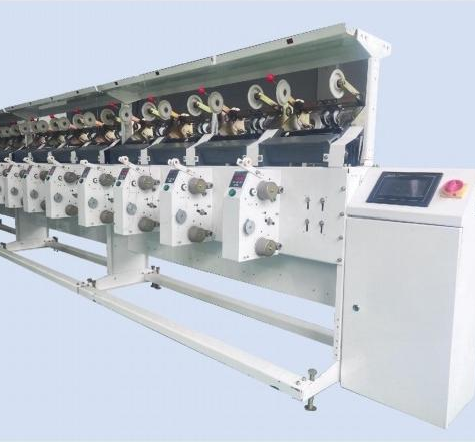
Importance of Double Winders in the Textile Industry
Structural Design and Main Components of a Double Winder
The Dual Spindle Arrangement
Motor and Drive Control System
Tension Control System
Yarn Guide and Traverse System
Frame and Machine Body
The frame is usually built from steel or aluminum alloy for durability and vibration stability. The structure must support high-speed winding while guaranteeing machine balance. The rigidity of the frame reduces vibration-induced tension fluctuations, ensuring consistent winding operations.
Operating Principles of a Double Winder for Stranded Yarns
Yarn Feeding and Guiding
Controlled Acceleration and Winding Speed
Package Formation
Automatic Stop Functions
To protect yarn quality, most double winders include automatic stop features triggered by yarn break sensors, full package detection, or tension irregularities. This ensures consistent package quality and reduces material waste.
Advantages of Double Winders for Stranded Yarns
Increased Production Efficiency
By accommodating two winding positions simultaneously, the double winder doubles output without doubling floor space. This supports high-volume operations and reduces downtime between batch changes.
Consistent Package Quality
The combination of controlled tension, precise traverse movement, and steady winding speed produces stable packages with uniform density. This consistency is essential for downstream processes such as dyeing and weaving.
Enhanced Yarn Surface Protection
Stranded yarns are more susceptible to abrasion and deformation. The double winder minimizes mechanical stress during winding, preserving the structure and enhancing final product durability.
Compatibility with Various Yarn Types
Double winders work with a wide range of stranded yarn categories, including natural fibers, synthetic yarns, blended strands, elastic yarns, and technical fibers. This adaptability makes the machine suitable for multiple textile sectors.
Reduction of Production Costs
Stable winding decreases yarn breakage and package rejection rates. Fewer defects result in lower operational costs and improved overall efficiency.
Application Areas of Double Winders for Stranded Yarns
Apparel and Fashion Textiles
Stranded yarns used in garments require tight quality control to maintain fabric consistency. Double winders support the production of yarns for sweaters, socks, denim, t-shirts, and intricate woven textiles.
Home Textiles and Furnishings
Products such as carpets, towels, curtains, and bed linens rely on stranded yarns for durability. Double winders ensure smooth package formation, crucial for weaving and knitting.
Industrial and Technical Textiles
Technical yarns used in ropes, hoses, filter fabrics, composite reinforcements, and geotextiles demand stable handling. Double winders maintain structural uniformity during winding, improving performance in industrial applications.
Sewing Threads and Embroidery
Thread producers depend on accurate winding to avoid knotting or irregular tension during sewing. Double winders help produce consistent thread packages suitable for high-speed sewing machines.
Yarn Dyeing Facilities
Yarn dyeing plants benefit from stable package density, which ensures even dye penetration. Double winders produce packages with predictable internal tension distribution, essential for uniform coloration.
Key Technical Parameters of a Double Winder for Stranded Yarns
Speed and Rotational Control
Winding speeds typically range from 600 to 1500 meters per minute, depending on yarn characteristics. Speed stability is crucial for maintaining strand integrity.
Tension Range
Stranded yarn winding typically requires low-to-medium tension, which may vary from 5 cN to 30 cN depending on fiber type and strand count. Electronic tension control systems provide precise adjustments.
Traverse Stroke and Winding Angle
Traverse strokes vary according to package size, commonly from 120 to 250 millimeters. The winding angle affects package shape and stability, with common angles ranging between 15 and 25 degrees.
Package Diameter and Weight
Double winders can accommodate bobbin diameters between 150 and 300 millimeters, depending on spindle size. Package weights may range from 500 grams to several kilograms.
Material and Component Durability
High-strength ceramics, polished metal guides, and wear-resistant components ensure that stranded yarns are handled smoothly without causing surface damage.
Integration of Double Winders into Modern Textile Lines
Automation and Intelligent Control
Modern winders integrate with production management systems, enabling remote parameter monitoring, real-time error detection, and process optimization. This enhances traceability and reduces manual intervention.
Compatibility with Upstream Equipment
Double winders can be installed after ring spinning frames, air-jet spinning units, covering machines, twisting machines, and drawing frames. Correct alignment ensures smooth yarn flow.
Energy Efficiency Considerations
New-generation double winders use variable-frequency drives and high-efficiency motors to reduce energy consumption while maintaining precise control. Energy savings are essential in large-scale production lines.
Maintenance and Serviceability
Easy-access panels, modular components, and intuitive control screens simplify machine maintenance. Regular cleaning of yarn paths and inspection of spindle bearings ensures long-term reliability.
The Growing Importance of Double Winders in Global Textile Development
Responding to Demand for High-Quality Yarn
With increasing demand for better durability, color-fastness, and fabric uniformity, stranded yarn producers must maintain consistent winding quality. Double winders play a vital role in meeting such expectations.
Supporting Sustainability Efforts
Stable winding reduces waste generated from yarn breakage and package defects. Energy-efficient motors and optimized production workflows contribute to sustainable textile operations.
Alignment with Industry 4.0 and Smart Manufacturing
Digital controls, real-time monitoring, and integration with intelligent textile systems enable double winders to become part of automated production environments that improve efficiency and reduce labor intensity.