


 English
  Hungarian
  Indonesian
  Bulgarian
  Turkish
  Polish
  Russian
  Spanish
  Portuguese
  Korean
  French


In the contemporary textile world, productivity and accuracy are major factors that highly influence the quality of yarn and its production cost. Out of all the spinning and twisting technologies available, it is only the Two for One machine (TFO) that can be defined as one of the latest systems, besides being used on a large scale to obtain high-quality twisted yarns.
This article covers a detailed description of what exactly a two-for-one machine is, how it operates, the kind of yarns it works with, and ways through which one can select an appropriate model to carry out his or her textile operations efficiently. Therefore, a yarn manufacturer, an equipment supplier, and even a textile engineer ought to understand the TFO machine very well to optimally perform their product quality.
What Is a Two for One machineMachine?
A Two for One machine, or TFO machine, is so named because with the twisting of single or multiple yarns, it delivers double the twist per rotation of the spindle. It is intended primarily for the manufacture of strong, smooth, and uniformly consistent yarns used in weaving and knitting, as well as carpets and industrial fabrics, and technical textiles.
How It Differs from Conventional Twisters?Conventional twisters give one twist per revolution. In the TFO machine, two twists are given to the yarn. One twist is during its travel through the spindle, and the other is by way of a balloon over the spindle pot. This doubles production, thus ensuring better uniformity of twist.
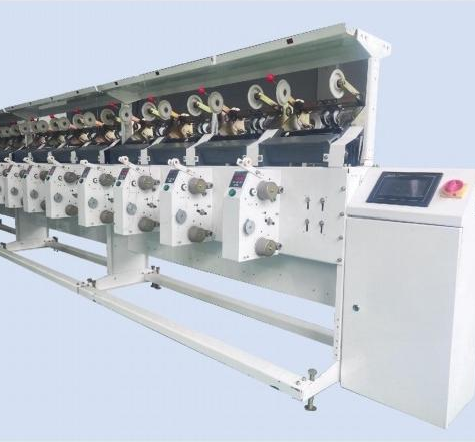
How Does a Two for One machineWork?
The TFO machine works on basic rotational mechanics and controlled tensioning.
Yarn Feeding:
A single yarn is fed from a supply package, say a cone or bobbin that sits on the spindle.
Yarn Path:
This yarn travels through the hollow spindle, coming out via a ceramic guide, creating a balloon shape as it rotates around the pot of the spindle.
Twisting Action:
First twist-as the spindle rotates, the yarn gets twisted once during its passage through the spindle. Second twist-as the balloon unwinds, it gives another twist in the same direction. → Therefore, each spindle revolution gives two twists.
Take-Up and Winding:
The twisted yarn is taken up on a take-up package (cone or tube) under controlled tension.
Control Systems:
Contemporary TFO units apply variable frequency drives (VFDs), PLC direction, and electronic strain sensors to keep up the specificness of the level of twist and to minimize breakage.
Yarn Types Suitable for a Two for One machine
The TFO machine accommodates all fibers and yarns-from natural cotton to high-performance industrial filaments.
Cotton Yarn
It is used as a woven fabric and a knit fabric. Medium levels of twists are required to achieve the strength and evenness of the yarn. TFO gives better compactness, less hairiness compared to ring twisting.
Synthetic Yarns (Polyester/Nylon)
Used for apparel and upholstery fabrics, also for technical fabrics. It requires a very prescribed tension and steady temperature to avoid filament breakage,
TFO machines often have anti-static guides for synthetic fibers.
Carpet Yarn:
Normally comprised of high-denier multifilament or staple blends. TFO imparts not only uniform twist but also bulk, which translates into pile resilience. It is applied in the production of BCF (bulk continuous filament) yarn.
Industrial Yarn:
The product covers nylon 6, nylon 66, polyester industrial filaments, and aramid fibers. TFO processing increases tensile strength, elongation balance, and cohesion. Applications are mostly belts, ropes, tire cords, and geo-textile.
Functional and High-Strength Fibers:
Kevlar, Nomex, Dyneema, carbon fiber precursor yarns, among others. Requires special low-tension spindles; temperature-stable spindles.
False-Twist and Texturing
In modern TFO machines, a false-twist or heat-set attachment may be used for crimping and bulking the yarn. It is common in textured polyester intended for knitting uses.

Two for One machine Process
A Two for One machine is a textile machine that throws single yarn into two or more plies. It is mostly used for the production of high-strength, low hairiness yarn and finds extensive usage in nylon, polyester, cotton, filament, and industrial yarn processing.
The basic principle behind two-for-one twisting is such that in one revolution of the main spindle per turn, the yarn gets double the amount of twist insertion; hence, it has been named a Two for One machine.
Creeling
Yarn is loaded into the creel. Normally, it is a single filament or spun yarn. Bobbins are tied individually so that there is no entanglement taking place; hence, tension control must be uniform at this stage to avoid breakages of yarn.
Yarn Guiding and Threading
Drawn from the supply bobbin, it passes through a yarn guide hook, ceramic eyelet, and tensioner before entering the two-for-one twisting spindle. This operation ensures proper tension of the yarn that is about to go inside the main spindle, where actual twisting will take place.
Main Spindle Twisting Zone
Spindle Twisting Area — This constitutes the heart of the Two for One machines. As yarn travels through the main spindle, the Rotating action of the main spindle provides motion to a twisting disc, thereby enabling the yarn to get two twists as it moves via the spindle’s bottom hole. A wider twist means stronger and denser yarn. It can be set either in S or Z twist directions.
False Twist & Reverse Twist
Some machines apply a reverse or false twist to better set the yarn in structure. In this way, it makes the finished yarn more compact and less prone to loosening. This is the preferred use of high-stretch yarn.
Take-up & Winding
After the yarn has been twisted, it will go through yarn guides and a shaping device before finally being wound onto the package. Automatic package change, constant-tension winding, and electronic length counter are functions of high-end machines that create uniform package density with neat looks. 6. Quality Inspection and Packaging The finished yarn is packaged after testing for twist, strength, and evenness.
Yarn of high quality bears a smooth surface and an even twist when produced by a Two for One machine, ready to take dyes, finishes, or any weaving process that can be applied next.
| Process Stage | Main Equipment/Components | Key Control Parameters | Function Description |
| Creeling | Creel, Guide Eye | Uniform tension | Ensures even feeding tension |
| Threading | Ceramic guides, Tension device | Stable yarn speed | Prevents yarn breakage and fuzz |
| Twisting | Main spindle, Disc, Spindle hole | Twist level, Spindle speed | Forms double twist per revolution |
| Take-up | Guide bar, Winding unit | Winding density | Ensures neat and consistent package shape |
| Inspection | Twist tester, Strength tester | Twist variation ±1% | Guarantees consistent yarn quality |
Key Selection Parameters for a Two for One machine
Choosing the right TFO model involves evaluating both technical parameters and operational efficiency.
| Parameter | Description | Typical Range / Options |
| Machine Type | TFO / False-twist / Composite model | Standard TFO or Heat-Set TFO |
| Spindle Count | Determines output and footprint | 100–800 spindles per machine |
| Yarn Count Range | Ne or tex (indicates yarn fineness) | 10–100 Ne or 20–1000 tex |
| Max Speed | Spindle speed in rpm | 8,000–16,000 rpm |
| Tension Control | Mechanical or electronic (servo-based) | Closed-loop system preferred |
| Programmability | Data memory, twist preset, auto-stop | PLC + touch screen |
| Auto Doffing / Stop | Automatic yarn doffing and break sensors | Optional |
| Energy Consumption | Measured per spindle | 0.2–0.4 kWh/spindle |
| Floor Space | Dependent on spindle layout | Compact or long-frame |
Measuring the Productivity of a Two for One machine
Production capacity in TFO machines depends on spindle number, yarn speed, and efficiency.
Spindle Count
The throughput is directly determined by the number of spindles-more spindles, more output, greater energy use.
Rpm
The higher the rpm, the greater the productivity; yarn breakage may result if tension is not properly controlled. Most industrial TFOs operate within a range of 10,000-14,000 rpm for synthetic yarns.
Yarn Count and Ply
Fine yarns require lower tension with smaller balloons; coarse yarns can run at higher speeds.
Advantages of Two for One machines
An essential key item of apparatus in the contemporary textile business, Two for One machines convey different execution and financial benefits.
Stable Twist and High Quality
The structure of the Two for One machine allows the yarn to gain two twists per revolution of the spindle. \When compared to ordinary single-twisters, better-quality yarn is produced with more uniform twisting and more stable yarn evenness.
Increased strength of the yarn means less breakage; hence, the fabric will be finished smoothly and cleanly, which can be used on high-end textiles.
High Production Efficiency
Since it works on the principle of ‘one-turn, two-twist,’ the output from a Two for One machine can be more than double what is achieved with a conventional twister.
It features a high degree of automation that does not disrupt production but rather makes bobbin changing automatic as well as monitoring being online, thereby greatly reducing labor costs.
Energy Conservation and Consumption Minimization
Low Consumption. The latest Two for One machines work under variable frequency speed control with a high-efficiency spindle design:
- Reduced main motor energy consumption by 10%-20%,
- More precise twist control, therefore reduced yarn waste,
- Some models incorporate a centralized oil supply and lubrication system that further reduces maintenance costs.
High Suitability
The Two for One machine applies to the materials of various yarns, such as:
- Polyester,
- Nylon,
- Cotton,
- Viscose,
Industrial yarn (for example cord, sewing thread, covered yarn).
It helps make all kinds of yarn, from really thin to quite thick.
Formation of Package
The Electronic Yarn Guide (EPC) enables exact control over the take-up angle and density, resulting in package formation of a regular shape, which includes better dyeing and weaving, with reduced breakage at the very end of downstream processing.
Simple Maintenance, Long Service Life
This Two for One machine adopts a stable frame running balanced transmission with low vibration. It can run for more than 10,000 hours owing to high-precision bearings and parts made out of wear-resistant material. The time interval between maintenance is long, thereby reducing repair costs.
Main Application Fields of Two for One machines
- TFO machines find their place very useful in several segments of the textile industry, e.g.,
- Knitting and Weaving Yarns – compact yarns with low hairiness for fabrics.
- Carpet Manufacturing – twisted filament yarns used for pile facing, having high resilience.
- Industrial Textiles – ropes, hoses, belting, and tire cords.
- Embroidery Threads – color and tension consistency.
- Technical and Specialty Yarns – conductive or flame-retardant fibers enabled by TFO design flexibility, producing customized yarn structures meeting requirements of today’s smart-textile applications.
How to Choose the Right Two for One machine?
The choice of a TFO machine should be strategically based on the type of material, production goals, and budget.
Define Yarn Type:
Are you processing cotton, polyester, or high-tenacity nylon? This will require different spindle designs and tension controls.
Evaluate Machine Type:
Standard TFO for cotton and synthetic staple fibers, False-Twist TFO for crimped and textured yarns, Composite TFO combines twisting with winding or heat setting.
Capacity and Layout:
Available space
Required spindle number
Output targets per shift
Check Automation Level
Present-day Machines give:
Touch-screen PLC Interface
Automatic Doffing Yarn Break Sensors
Centralized Lubrication and Monitoring
Assess Supplier Reliability
Look for:
- Proven References in Textile Plants
- Spare Parts Availability
- Energy Efficiency
- Data After-Sales Technical Support
Maintenance and Care of a Two for One machine
Proper upkeep results in steady product quality and extends the life of the machine.
Daily Care
Clean yarn guides and ceramic eyes.
Look at drive belts and tension sensors.
Take lint and dust out of the spindle pots.
Weekly/Monthly Looks
See spindle balance and bearing wear.
Lubrication levels and filter cleanliness should be checked.
Tension settings and calibration should be looked at.
Yearly Overhaul
Spindles, belts, and bearings that are worn.
Replace PLC parameters and sensors that need to be set correctly.
Safety systems (emergency stop, auto stop) need to be tested.
Preventive maintenance lowers downtime and makes MUR better.
Common Problems and Troubleshooting
| Issue | Possible Cause | Recommended Solution |
| Uneven Twist | Tension imbalance or spindle misalignment | Recalibrate tension sensors |
| Yarn Breakage | Excessive speed or balloon friction | Reduce rpm, check guides |
| Oil Stains | Over-lubrication or leak | Inspect and clean lubrication system |
| Poor Winding | Faulty traverse system | Adjust winding parameters |
| Noise/Vibration | Worn bearings or unbalanced spindles | Replace defective parts |
Conclusion
Two for One machines belong to the category of ultra-modern yarn making, which creates results so balanced with efficiency, precision, and consistency—something that was never achieved using the older systems.
The machines enable twisting two times in one rotation of the spindle thereby increasing productivity by an energy consumption reduction per kilogram as well as improved performance of yarn for both apparel and technical textile applications.
Consideration while selecting a TFO: Yarn compatibility, spindle speed, and tension control. Programmability and after-sale support. Regular machine maintenance for maximum uptime with uniform quality. As the textile industry is evolving towards automation and smart manufacturing, TFO machines play a very important role as a connecting link between the conventional spinning process and the developed textile processing.