


 French
 English
 Hungarian
 Indonesian
 Bulgarian
 Turkish
 Polish
 Russian
 Spanish
 Portuguese
 Korean


Une machine de teinture textile ne se choisit pas uniquement en fonction de sa capacité. La forme du textile, la chimie des fibres, la construction du tissu, la teinte souhaitée, la taille des lots, la consommation d'eau et la sensibilité à la manipulation influencent tous la décision correcte. Une machine qui produit un tricot polyester uniforme peut être le mauvais choix pour un voile délicat, un paquet de fils ou un effet de lavage sur vêtement.
This guide organizes the main types of dyeing machines around the decisions a mill actually faces. It explains yarn dyeing machine systems, fabric dyeing equipment, jet dyeing machine operation, the dyeing process in textile, and practical selection criteria. It is written for production teams, buyers, and new engineers who need a useful overview before comparing detailed specifications.
Quick Answer: How Are Dyeing Machines Classified?
Dyeing machines are commonly classified first by the form of material: loose fiber, yarn, fabric, or garment. They can also be grouped by whether dye liquor moves, whether the material moves, and whether the system is open or enclosed. The most common fabric dyeing equipment includes jet, jigger, beam, winch, overflow, soft-flow, and pad dyeing ranges. Each creates a different balance of tension, liquor ratio, throughput, and shade control.
Start with the Material Form
| If you are dyeing… | Start by considering… | Why this route fits |
| Loose fiber before spinning | ||
| Stock or loose-fiber dyeing machine | ||
| It colors fiber before blending and spinning into yarn. | ||
| Yarn for stripes, checks, or patterns | ||
| Package, hank, or warp yarn dyeing machine | ||
| It colors the yarn before fabric construction. | ||
| Fabric in solid shades | ||
| A fabric dyeing machine | ||
| It colors the woven or knitted material as a piece. | ||
| Finished apparel for a washed look | ||
| Garment dyeing machine | ||
| It creates color variation around seams and details. |
The Dyeing Process in Textile: What the Machine Must Control
Every dyeing process in textile needs controlled preparation, dye application, temperature management, circulation, fixation, washing-off, and final inspection. The exact recipe depends on fiber and dye class, but the equipment must move heat and liquor evenly while treating the material gently enough to preserve its dimensions and surface. Levelness comes from a stable relationship between material, liquor, time, temperature, pH, auxiliaries, and mechanical action.
A textile dyeing machine therefore does more than hold a bath. It controls liquor flow, fabric or yarn movement, pressure, heating and cooling rate, dosing, sample points, filtration, and discharge. Modern systems can improve repeatability through programmable recipes and measured additions, but they still require suitable preparation and disciplined operation. A sophisticated machine cannot correct a poorly prepared substrate or an unsuitable dyestuff system.
Fiber and Yarn Dyeing Machines
Loose-Fiber or Stock Dyeing
Loose-fiber dyeing colors staple fiber before spinning. The material is packed in a vessel and dye liquor circulates through it. This route supports heather effects and blended color yarns because different colored fibers can be mixed before spinning. It demands even packing and reliable liquor flow; poorly packed fiber can dye unevenly or develop density-related variation.
machines de teinture en paquet
A package yarn dyeing machine colors yarn wound on perforated cones, cheeses, cops, or similar carriers. Liquor is forced through the yarn package, often in alternating directions, to reach the inner and outer layers. This is widely used for yarn intended for stripes, checks, jacquards, socks, towels, and woven shirting. Package density, winding quality, carrier design, and flow reversal all influence penetration and levelness.
Hank and Warp Yarn Dyeing
Hank dyeing treats yarn in loose skeins and is valued where softness, bulk, or delicate yarn handling is important. Warp dyeing treats yarn in warp form before weaving and is essential for some denim and yarn-dyed constructions. These methods are selected for the required visual effect and downstream process, not simply for the lowest dyeing cost.

La teinture en paquet fait passer le liquide à travers le fil enroulé afin d’atteindre uniformément l’ensemble du paquet.
Main Types of Fabric Dyeing Machines
Machine de teinture par jet
A jet dyeing machine is a closed, pressurized system that carries fabric in rope form with a high-velocity stream of dye liquor. In many designs, the liquor flow helps transport the fabric while also delivering heat and chemicals. Jet dyeing is common for polyester, synthetics, blends, and many knit fabrics because it can operate at elevated temperature and pressure while avoiding the flat-width tension of a jigger.
Jet systems are not identical. Nozzle design, liquor ratio, fabric speed, loading, and rope path affect abrasion, crease risk, and energy use. Delicate fabrics need a gentle transport arrangement; heavy fabrics may need a different nozzle and circulation condition. Sample dyeing and production trials are essential before setting a new fabric style on a jet route.
Jigger Dyeing Machine
A jigger dyes fabric in open width. The fabric passes back and forth between two rollers through a relatively small dye bath. This approach suits stable woven fabrics that can tolerate controlled tension. Because the cloth stays flat, it can reduce rope-crease risk. It is not generally the first choice for highly elastic or delicate knit constructions, which may distort under tension.
Beam Dyeing Machine
A beam dyeing machine winds fabric onto a perforated beam placed inside a vessel. Liquor is pumped through the fabric package while the material remains largely stationary. The method is useful for lightweight, open-width, or tension-sensitive fabrics where crease prevention and low mechanical movement matter. Uniform winding and correct liquor distribution are critical; poor beam preparation can produce channeling and shade differences.

La teinture en faisceau fait circuler la liqueur à travers le tissu enroulé sur un faisceau perforé.
Winch, Overflow, and Soft-Flow Machines
Winch dyeing moves a rope of fabric slowly through liquor with a reel or winch. It can be gentle and is traditionally used for fabrics that benefit from soft handling. Overflow and soft-flow machines use liquor transport with designs intended to reduce tension and abrasion. They are often considered for knitted fabrics, delicate synthetics, and materials where surface quality is a high priority. The correct choice depends on fabric weight, rope behavior, loading, and the desired handfeel after dyeing.
Pad Dyeing and Continuous Ranges
Pad dyeing uses a trough and squeeze rollers to impregnate fabric with controlled dye liquor pickup. It is part of a continuous or semi-continuous dyeing route, often followed by batching, steaming, thermosol treatment, or washing depending on the fiber and dye system. Padding ranges can be efficient for long, consistent orders because they process fabric continuously. They require accurate pickup control, stable chemistry, and good synchronization across the full range.
Quick Machine-Selection Matrix
| When your top priority is… | A practical starting option | Confirm this before purchase |
| Low-tension processing for many knits and synthetics | ||
| Jet dyeing machine or soft-flow system | ||
| Rope transport, nozzle action, liquor ratio, and crease control. | ||
| Flat-width handling of stable woven fabric | ||
| Jigger dyeing machine | ||
| Tension, edge tracking, and suitability for the construction. | ||
| Minimal movement for delicate open-width material | ||
| Beam dyeing machine | ||
| Beam winding density and even liquor circulation. | ||
| A soft hand on sensitive fabric | ||
| Winch, overflow, or soft-flow machine | ||
| Loading, rope marks, and surface abrasion risk. | ||
| Long, repeatable production orders | ||
| Pad dyeing or continuous range | ||
| Pickup control, fixation route, and process synchronization. |
How to Select the Right Dyeing Machine
Start with the material form and fiber. Cotton, wool, nylon, polyester, acrylic, elastane blends, and regenerated cellulosics have different temperature, pH, and dye-class requirements. Then consider fabric construction. A stable poplin, a lightweight voile, a bulky terry, and an elastane jersey may all need different handling even if their fiber composition overlaps.
- Define textile form: fiber, yarn, fabric, or garment.
- List fiber content, construction, weight, stretch, and surface sensitivity.
- Set batch size, shade-repeatability requirement, and delivery schedule.
- Compare material-to-liquor ratio, heating, cooling, water use, and recovery options.
- Review automation, dosing, filtration, sampling, and recipe traceability.
- Confirm safety systems, service access, spares, training, and integration with washing and drying.
Capacity alone can mislead. A larger machine may lower unit cost when it is well loaded, but it can be inefficient for short color runs or development work. A flexible machine with smaller vessels may improve responsiveness for a brand with many shades and frequent changeovers. The best investment is the one that fits the real order profile and quality target.
Water, Energy, and Chemical Efficiency
Material-to-liquor ratio is an important selection measure because lower liquor volume can reduce water, heating energy, salt or auxiliary consumption, and effluent load. It is not the only measure. A low ratio must still provide level circulation, safe pump performance, and reliable temperature control. A poorly controlled low-liquor process can create re-dyeing and waste that erase the expected savings.
Evaluate a full cycle: filling, heating, dyeing, rinsing, washing-off, cooling, draining, and cleaning. Features such as heat recovery, automated dosing, insulation, reuse of suitable process water, and optimized rinse sequences can improve resource performance. The relevant question is not whether a machine has a sustainability label; it is whether its measured operation fits the mill’s substrate, recipes, utilities, and compliance obligations.
Quality Control and Common Defects
Color matching starts before bulk production with a laboratory recipe and approved standard. During the run, operators check temperature profile, pH, liquor circulation, addition timing, and material movement. After dyeing, inspection under standardized light verifies shade, levelness, spots, streaks, creases, and contamination. A shade that looks correct in one light source may not match in another, so controlled viewing conditions matter.
- Uneven shade: check liquor distribution, packing, circulation, and temperature uniformity.
- Crease marks: review rope transport, loading, dwell time, and fabric preparation.
- Poor penetration: inspect package density, beam winding, flow direction, and recipe.
- Patches or spots: check filtration, chemical dissolution, dosing, and cleanliness.
- Shade-to-shade variation: verify recipe control, batch preparation, and color measurement.
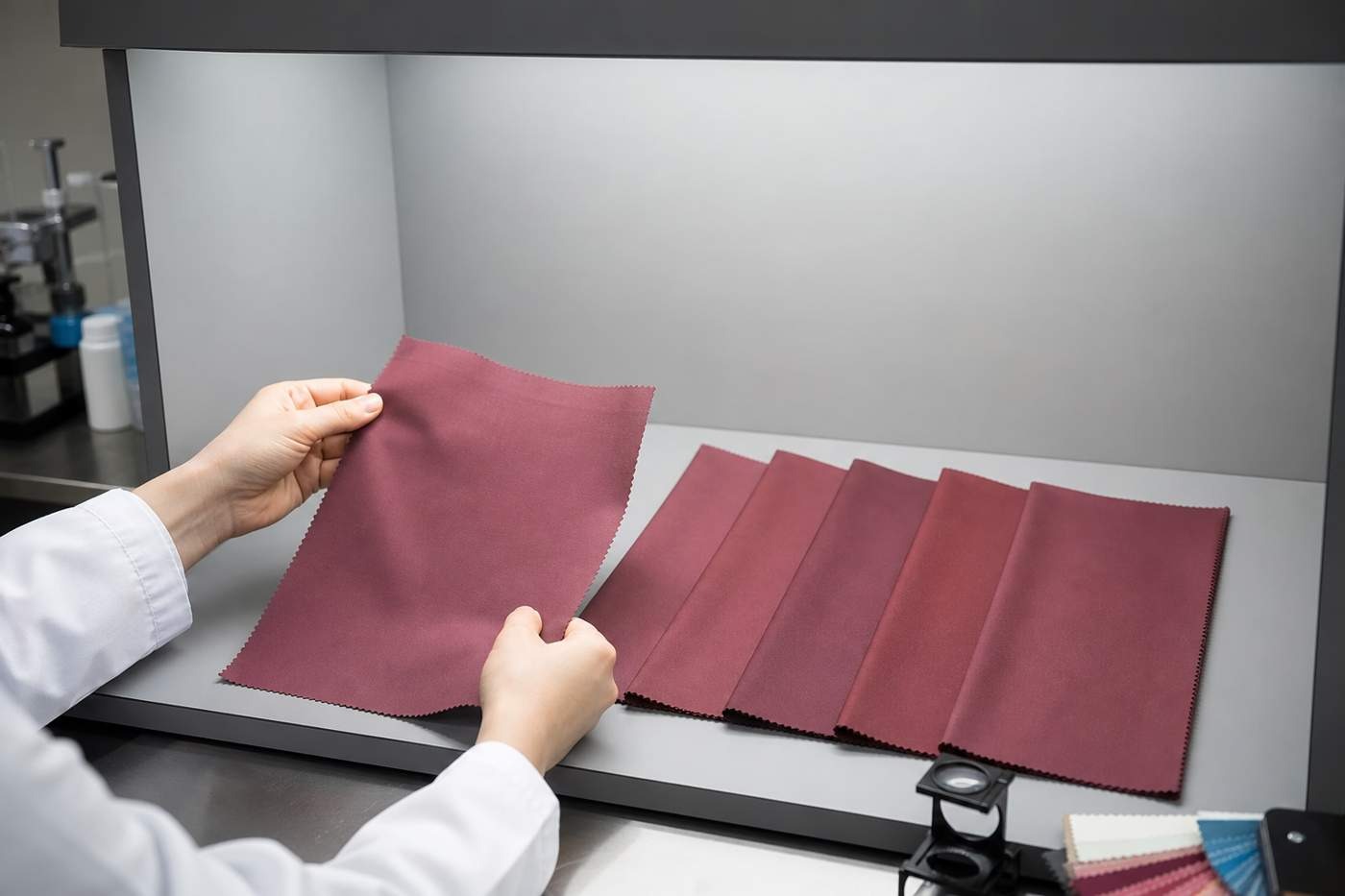
L’approbation de la teinte et le contrôle de l’aplomb sont indispensables avant que le tissu ne soit acheminé vers la finition.
Maintenance and Safe Operation
Dyeing equipment combines heat, pressure, chemicals, pumps, and moving fabric. Safe operation requires the manufacturer manual, trained operators, approved recipes, and site procedures. Inspect seals, valves, pumps, filters, heat exchangers, sensors, dosing lines, and safety interlocks regularly. Cleanliness supports both safety and shade quality because residual dye or auxiliaries can contaminate a later lot.
Preventive maintenance should be linked to real operating conditions. A machine running high-temperature polyester cycles, dark shades, or frequent color changes may need a different cleaning and inspection schedule from a machine running light cotton shades. Track alarms, pump load, temperature deviations, leaks, and cycle time so maintenance can address trends before they become production losses.
Questions fréquemment posées
When a new fabric is introduced, run a documented pilot before scheduling bulk production. Confirm loading method, circulation direction, liquor ratio, heating curve, dosing sequence, wash-off route, and finishing response. Keep the approved pilot sample with the recipe record. It becomes a practical reference for operators and quality teams when the same style returns months later or moves to another production line.
A successful dyehouse also plans for people. Operators need practical training in loading, sampling, cleaning, safety checks, recipe confirmation, and response to abnormal alarms. Supervisors need clear escalation rules for shade deviations, circulation problems, temperature drift, and fabric damage. Training should use the actual machine, actual control screens, and representative fabric styles. Written procedures support consistency, but they are most effective when operators understand the reason behind each step and can recognize early warning signs during a cycle.
Managing Dyeing Risk Before It Reaches the Customer
The dyehouse should treat every lot as a controlled process rather than a color-only operation. Check incoming fabric or yarn for lot variation, oil contamination, width variation, package density, and physical defects. These issues can change how the material takes dye. A recipe developed on one lot may need a controlled adjustment on another, especially where fiber sources or pretreatment conditions differ. Keeping traceable lot records makes it easier to understand a later shade question.
Sampling points are valuable when used consistently. A sample taken after a key temperature stage or after a controlled chemical addition can show whether the batch is moving toward the approved shade. Color measurement instruments support objective comparison, while visual evaluation remains important for metamerism, surface effects, and customer perception. The best practice combines instrument data, standard lighting, trained judgment, and a documented approval route.
Choosing Between Batch and Continuous Dyeing
Batch dyeing gives flexibility. It suits short to medium orders, varied colors, development work, and fabrics that need individual treatment. Jet, beam, jigger, package, and winch systems fit within this broad family. Their cycle time may be longer per meter, but they can respond to changing demand and offer close control over a defined lot.
Continuous or semi-continuous routes favor long, stable orders. Pad-dry, pad-steam, pad-batch, and related ranges reduce repeated vessel loading and can offer high throughput. They require careful control because a problem can affect a large length quickly. The right route depends on forecast accuracy, shade volume, fabric stability, available finishing equipment, and the cost of changeovers. Many successful dyehouses use both approaches for different parts of their product mix.
A Final Procurement Checklist
Before placing an order, compare the complete operating picture: purchase price, installation, utilities, operator training, chemical automation, cleaning time, spare parts, local service, energy use, water management, and integration with existing preparation and finishing. Ask the supplier to explain the expected performance in your material categories, not just in a generic demonstration. Require documented trial conditions and a clear handover plan.
A machine is a long-term production platform. The best decision leaves room for new fabrics, changing color demand, stricter environmental expectations, and future automation. A thoughtful selection process may take longer at the start, but it protects shade quality, delivery reliability, and operating cost for years after installation.
Selection Scenarios: Match Equipment to the Job
A practical selection guide should end with real production situations. Consider a mill that dyes polyester athletic knit in many shades. It needs pressure capability, gentle rope transport, short turnaround, recipe repeatability, and careful protection from crease marks. A jet or soft-flow system may be evaluated because it combines closed-vessel processing with fabric circulation. The exact choice still depends on fabric weight, elastane content, loading range, and the mill’s standard recipes.
Now consider a shirting mill dyeing stable cotton or polyester-cotton woven fabric in open width. It may prioritize flat-width handling, edge control, and repeatable solid shades. A jigger or continuous pad range can be relevant depending on order length. For a lightweight, crease-sensitive woven, beam dyeing may be more suitable because the fabric remains wound and liquor circulates through it. These examples show why “best dyeing machine” is not a useful question without a material and order context.
Automation, Dosing, and Recipe Management
A modern textile dyeing machine can include programmable control, automatic chemical dosing, temperature-profile management, flow monitoring, and digital batch records. These features can reduce variation when they are supported by accurate recipes and trained staff. Automated dosing is particularly useful where small additions, timed additions, or multiple auxiliaries affect levelness. It also reduces manual handling of chemicals and makes traceability easier.
Automation does not replace dyehouse knowledge. Operators still need to understand why a recipe uses a particular heating rate, salt addition sequence, pH correction, or circulation direction. If a batch deviates from its expected profile, the team should know whether to hold, correct, sample, or stop the process. A well-designed interface and clear standard operating procedures turn machine data into better decisions rather than more alarms.
Planning Capacity and Changeovers
Capacity planning is more complex than multiplying vessel size by the number of machines. A dyeing cycle includes loading, filling, heating, dyeing, rinsing, washing, cooling, draining, unloading, cleaning, and sampling. Dark shades, sensitive fibers, and highly specified colors may require longer cycles. Frequent color changes can add cleaning time. A short-run fashion business may value small flexible vessels, while a basic fabric producer may benefit from larger continuous capacity.
Group production intelligently. Similar shades, fibers, and chemistry can reduce cleaning effort and contamination risk. Light shades after dark shades may require a more rigorous cleaning route. Keep a realistic buffer for laboratory approvals, reprocessing decisions, and maintenance. A dyeing machine delivers its best value when the mill schedules it around true cycle time and quality capacity, not only theoretical meters per day.
Acceptance Criteria for a New Dyeing Machine
Before purchasing, define how you will accept the machine. Use representative fabric styles, fibers, shades, and batch sizes during trials. Review shade levelness, fabric appearance, crease marks, repeatability, liquor ratio, utility use, cycle duration, alarms, accessibility, and cleaning time. Specify the test method or approval standard whenever possible. This prevents a vague “good result” from becoming a disagreement after installation.
Also assess the operating environment. Confirm available steam, electricity, water quality, compressed air, drainage, chemical transfer, ventilation, floor loading, and space for loading equipment. Consider access for pumps, seals, filters, heat exchangers, and controls. A machine may have strong dyeing performance yet become costly if its maintenance needs do not fit the plant layout. Site preparation and service planning belong in the selection decision from the beginning.
The Link Between Dyeing and Downstream Finishing
Dyeing is one stage in a longer fabric route. The way material is dyed can affect drying, heat setting, washing, softening, coating, printing, sueding, and final inspection. Rope marks or width variation may become more visible after finishing. Residual chemistry can affect coating adhesion or handfeel. Dyehouse and finishing teams should therefore agree on width targets, residual moisture, wash-off quality, shade tolerance, and roll handling before bulk production starts.
The same coordination supports customer satisfaction. A buyer may approve a lab dip, but the final fabric also needs to meet handfeel, dimensional stability, colorfastness, and appearance standards after finishing. Connecting the dyeing process to downstream performance leads to fewer surprises, clearer responsibility, and a more reliable finished textile.
Which dyeing machine is best for knit fabric?
Jet, overflow, or soft-flow systems are often evaluated for knit fabric because they can reduce tension compared with flat-width systems. The best choice depends on weight, stretch, surface sensitivity, and batch size.
What is a yarn dyeing machine used for?
It colors yarn before weaving or knitting. Package, hank, and warp systems support yarn-dyed effects such as stripes, checks, denim warps, and patterns.
What is the main advantage of beam dyeing?
Beam dyeing can handle fabric in open width with low movement, which helps when crease prevention and tension-sensitive fabrics are priorities.
Why is a jet dyeing machine used for polyester?
Closed jet systems can provide the high-temperature, pressurized conditions commonly required for polyester dyeing, while moving fabric in rope form through circulating liquor.
Final Takeaway
The best dyeing machine is the one that matches textile form, fiber behavior, fabric construction, order profile, and quality requirement. A yarn dyeing machine solves a different problem from a jet dyeing machine or a continuous padding range. Selecting by the finished product and production route gives a better result than selecting by capacity alone.
For a technical discussion about textile dyeing machine options and process requirements, visit Sutexmach. Start with your material, target shade, batch profile, utility limits, and desired quality controls.