


 Turkish
 English
 Hungarian
 Indonesian
 Bulgarian
 Polish
 Russian
 Spanish
 Portuguese
 Korean
 French


Tek bir titreşimli iğne, tüm bir tekstil üretim hattını durdurabilir mi? Günümüzde sorunsuz makineler hayatta kalmak için çok önemlidir. İstenmeyen titreşimler felaket boyutunda arızalara, bozulan kumaşa ve mali kayıplara yol açar. Bu yazıda, Tekstil Makinelerinde Titreşim: Sorun Giderme İçin En Önemli 7 Neden ve Çözümler üzerine derinlemesine inceleyeceğiz.
The Hidden Costs of Ignoring Textile Machine Vibration Causes

As we noted earlier, unwanted shaking ruins fabric and drains profits. But what exactly happens when you ignore tekstil makinesi titreşiminden kaynaklanan? The damage goes far beyond a noisy factory floor. It silently eats away at your product quality, machinery lifespan, and bottom line.
Plummeting Fabric Quality
Vibration directly impacts your final textile output. It causes uneven tension across the fabric web. This leads to severe irregularities during production. Unstable warp knitting machines produce obvious defects. You will easily spot dropped stitches or uneven loops.
The finishing process suffers just as much. A makaralı dengesizlik titreşimli cilalama hattı issue creates inconsistent calendering results. The pressure varies across the fabric width. This ruins the smooth finish. Similarly, vibrating dyeing machines cause uneven dye penetration. You end up with patchy, rejected fabric batches.
Accelerated Component Wear and Tear
Textile machines operate at high speeds. Even micro-vibrations cause massive damage over time. Bearings are the primary wear-point in these systems. When a machine shakes, it puts unnatural stress on these bearings. They fail much faster than their expected lifespan.
A misaligned spindle drive often causes resonance. This vibration travels through the entire machine frame. It causes premature wear on completely unrelated parts. You will find yourself constantly replacing servo motors, gearboxes, and expensive hydraulic valves.
Severe Financial Impacts
Ignoring the “rumble” hits your wallet hard. Vibrating equipment requires more power to operate. Motors work against the mechanical imbalance. This drives up energy consumption immediately. Your monthly utility bills will spike.
Then comes the maintenance cost. Unscheduled downtime is a nightmare for fabric mills. Critical vibration issues often demand 24/7 emergency support. You pay premium rates to fix sudden production line stoppages. The cost of replacing ruined fabric adds heavily to this financial drain.
Operator Safety Risks
We cannot ignore the human element. Heavy textile machinery is inherently dangerous. When a machine vibrates violently, it becomes unpredictable. Loose components can detach at high speeds. This poses a severe physical hazard to operators working nearby.
Excessive vibration also generates loud mechanical clatter. Long-term exposure to this environment harms operator hearing. It significantly increases workplace fatigue. Safety must always come first on the mill floor.
Vibration Impact Summary
At SutexMach, we have built intelligent textile machinery since 1985. We know exactly how vibration affects different production stages globally. Here is a quick breakdown of what happens when vibration goes unchecked:
| Affected Area | Direct Consequence | Long-Term Result |
|---|---|---|
| Çözgülü Örme | Uneven tension and dropped stitches | High fabric rejection rates |
| Calendering | Inconsistent roller pressure | Poor fabric finish and texture |
| Mechanical Parts | Excessive bearing and spindle wear | Frequent component replacement |
| Mill Operations | Sudden motor or drive failure | Unplanned downtime and emergency repair |
Tekstil Makinesi Titreşimi: En Önemli 7 Neden ve Çözümler
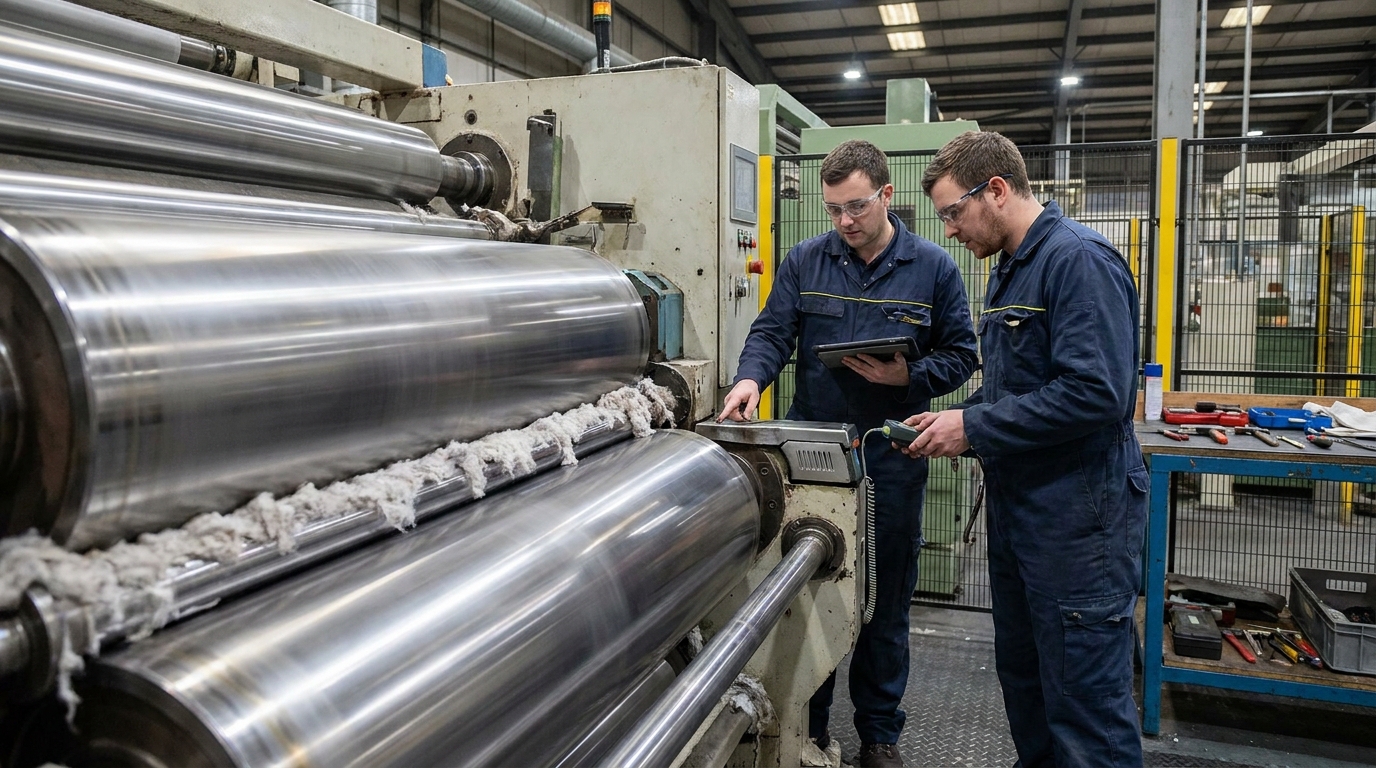
We just saw how unchecked shaking destroys fabric quality and causes unplanned downtime. Now, you must fix the problem. Finding the true source is your first step. Figuring out how to reduce machine vibration in textile mill environments requires a systematic approach. Here are the top seven triggers for these destructive rumbles and exactly how to resolve them.
Quick Diagnostic Guide
| Fault Type | Common Symptoms | Primary Fix Strategy |
|---|---|---|
| Roller Imbalance | Wobble in sueding or calendering machines | Dynamic balancing and daily cleaning |
| Bearing Wear | Grinding noises and high heat | Predictive monitoring and replacement |
| Misalignment | Radial and axial shaking | Precision laser alignment |
| Fluid Instability | Resonance in dyeing or drying units | Filter cleaning and pressure checks |
Cause 1: Roller Imbalance
Uneven weight distribution heavily affects finishing equipment. Sueding and calendering machines rely on perfectly balanced rollers. Lint buildup and chemical residue stick to roller surfaces over time. This creates a severe mechanical wobble.
- The Fix: You must establish a strict cleaning schedule. Remove fabric debris on a daily basis. Perform regular dynamic balancing on all rollers. This action quickly restores smooth machine rotation.
Cause 2: Bearing Wear and Degradation
As we covered earlier, bearings are the primary wear-point. They generate intense micro-vibrations when they degrade. You will notice unusual grinding noises and excessive heat. Recognizing tekstil makinelerinde yatak arızası belirtileri early saves your production run.
- The Fix: Implement a predictive maintenance routine immediately. Use vibration analysis sensors to read the rumble. Do this before you face a catastrophic failure. Apply proper lubrication and replace worn bearings quickly.
Cause 3: Mechanical Misalignment
Moving parts must align perfectly during high-speed operation. Misaligned shafts, pulleys, or drive belts create severe radial vibrations. They also cause damaging axial movements. This happens frequently in complex equipment like warp knitting machines. The resulting resonance travels through the entire machine frame.
- The Fix: Use precision laser alignment tools. Do this during initial installation and routine maintenance checks. Ensure all moving components remain perfectly parallel.
Cause 4: Structural Looseness and Foundation Issues
Continuous operation takes a heavy toll on machine frames. Mounting bolts and base plates slowly loosen over time. Sometimes, the concrete foundation itself cracks. This structural weakness amplifies normal operating movements into violent shaking.
- The Fix: Conduct routine visual structural inspections. Tighten all fasteners to the manufacturer specified torque. Repair any cracks in the concrete foundation immediately.
Cause 5: Motor and Drive System Faults
Vibration is rarely just a mechanical issue. Electrical imbalances or malfunctioning Variable Frequency Drives cause erratic movement. Degraded motor mounts also fail to absorb normal shocks. This combination creates rhythmic, destructive vibrations.
- The Fix: Perform standard electrical testing on AC/DC motors. Inspect drive belts and chains for proper tension. Ensure your motor mounts remain secure and highly shock-absorbent.
Cause 6: Gearbox and Gear Mesh Problems
Gearboxes handle immense torque during daily mill operations. Worn gear teeth or improper backlash lead to heavy shaking. A lack of adequate lubrication accelerates this internal wear. The resulting metal-on-metal friction causes distinct, heavy vibrations.
- The Fix: Conduct regular oil analysis on your gearboxes. Inspect gear tooth wear patterns during scheduled downtime. Always replace damaged gears using certified OEM parts.
Cause 7: Aerodynamic and Fluid Flow Instability
Uneven airflow causes hidden resonance inside your equipment. Fluid dynamics play a huge role in modern textile processing. This applies heavily to drying, dyeing, and air-softening machines. Unstable airflow or fluid pressure vibrates the internal structures. Our team at SutexMach has seen this since 1985. This issue often mimics standard mechanical failures.
- The Fix: Clean machine filters on a regular basis. Inspect fan blades for any damage or imbalance. Ensure your fluid pressure regulation systems function correctly.
How to Reduce Machine Vibration in Textile Mill Operations

We just explored specific fixes for everything from misaligned shafts to fluid flow instability. Fixing a broken gear pump stops today’s downtime. However, preventing that failure secures your future production. You need a solid long-term strategy. Let us look at a broader approach to keeping your mill running smoothly.
Move to Condition-Based Maintenance (CBM)
You must stop relying on reactive repairs. Waiting for a machine to shake violently guarantees lost fabric and emergency service calls. Instead, implement a proactive Condition-Based Maintenance program. This approach tracks actual equipment health. You schedule maintenance only when indicators show degrading performance. It prevents catastrophic spindle or motor failures before they happen.
Train Your Floor Team
Your operators are your first line of defense. Train machine operators and floor technicians thoroughly. They must visually and audibly recognize early warning signs. We call this practice “reading the rumble.” A sudden change in motor pitch often signals an electrical harmonic issue. A slight wobble points to mechanical imbalance. Catching these abnormal behaviors early saves expensive servo drives and gearboxes.
Invest in Modern Diagnostic Tools
You cannot fix what you cannot measure. Invest in modern vibration analysis tools. Handheld meters allow technicians to spot-check suspected problem areas quickly. Continuous monitoring sensors provide even better protection. They track equipment health in real-time. These sensors immediately alert your team to dangerous mechanical or electrical noise.
Step-by-Step Best Practices
Figuring out exactly how to reduce machine vibration in textile mill environments takes careful planning. You want to fix issues without causing unnecessary production halts. Follow these proven steps for the best results:
| Action Step | Implementation Method | Expected Result |
|---|---|---|
| Baseline Measurement | Record vibration levels on new or newly repaired machines. | Establishes a normal operating standard. |
| Routine Route Inspections | Use handheld meters during scheduled shift changes. | Catches intermittent faults without stopping production. |
| Component Isolation | Test AC/DC motors separately from mechanical gearboxes. | Identifies the exact source of the rumble. |
| Scheduled Rewinding | Send aging motors for comprehensive testing and rewinding. | Restores original balance and performance specifications. |
Establish Strict Operating Procedures
Finally, create Standard Operating Procedures for all maintenance tasks. These procedures must mandate regular calibration and inspection. Focus heavily on high-speed rotating components. Servo motors, feedback encoders, and spindles require extreme precision. At SutexMach, we build intelligent textile machinery for global fabric mills. We know strict calibration is the only way to eliminate micro-vibrations long-term. You should document every inspection carefully. Hold your maintenance team accountable to these strict standards.
Leveraging Expert Engineering for Vibration-Free Operations

We just discussed strict calibration and maintenance procedures. These steps keep your existing equipment running smoothly. However, the best way to eliminate vibration starts before installation. You must invest in intelligently designed machinery from the beginning. A poorly built frame will always shake. This happens no matter how often you align the spindles.
This is where expert engineering makes a massive difference. At SutexMach, we understand the exact physics of high-speed textile production. Our company was founded in 1985. For over 30 years, we have manufactured stable, intelligent textile machinery. Our team knows how to prevent destructive resonance right at the design stage.
We build heavy-duty frames to absorb normal operational shocks naturally. Our precision-engineered lineup includes sueding, calendering, and drying machines. We also build advanced stenter, dyeing, and warp knitting equipment. Global fabric mills heavily rely on our dewatering and air-softening machines. Every single unit undergoes rigorous dynamic balancing before leaving our facility. This proactive engineering prevents the severe bearing wear and roller imbalance issues we covered earlier.
Built-In Vibration Prevention
Precision engineering tackles the root causes of mechanical shaking directly. Here is how our intelligent machinery design protects your production floor:
| Makine Tipi | Engineering Focus | Vibration Prevention Benefit |
|---|---|---|
| Stenter & Drying Machines | Aerodynamic airflow design | Eliminates fluid flow instability and internal resonance. |
| Calendering & Sueding | Precision dynamic balancing | Prevents roller wobble and uneven fabric tension. |
| Warp Knitting Equipment | Reinforced structural frames | Absorbs high-speed radial and axial movements safely. |
You need more than just a heavy machine base. You need a highly reliable manufacturing partner. SutexMach operates as a proud affiliate of Jiangsu SoHo Honry Import & Export Co., Ltd. This strong backing ensures we source only the highest-quality components. We integrate premium servo drives and heavy-duty gearboxes into every build. We also use perfectly aligned hydraulic actuators to ensure smooth movement.
Strong engineering extends directly to your long-term operational reliability. Partnering with a globally trusted manufacturer secures robust machine frames. You also gain immediate access to reliable long-term technical support. Our engineers help you implement those critical condition-based maintenance routines. We ensure your production lines run smoothly and quietly for decades.
Sonuç
Finding the true root cause of vibration is vital. Whether facing bearing failure, misalignment, or roller imbalance, quick action saves money. Combine predictive maintenance with high-quality equipment to stop these issues. Audit your current textile machines today. Trust SutexMach’s thirty years of experience for flawless fabric production.
- Schedule a vibration audit for all rotating equipment.
- Install continuous monitoring sensors on older textile machines.
- Contact SutexMach to explore precision-engineered machinery options.
Frequently Asked Questions About Textile Machine Vibration
How can I tell if vibration is mechanical or electrical?
Mechanical issues usually cause a steady, consistent shaking. Electrical problems will often act quite differently. They often change with the load or machine speed. You might notice strange harmonics from the drive. Try checking the servo feedback cables first. Signal noise can easily mimic a mechanical problem. Technicians use vibration analysis to find the exact cause.
Why do my textile machine spindles vibrate at certain speeds?
This happens due to mechanical imbalance or system resonance. Misaligned spindle drives can shake the entire machine frame. This shaking causes premature wear on unrelated bearings. Sometimes, the problem only appears during specific cycles. SutexMach designs intelligent machinery to minimize these harmful vibrations. Always ensure your spindles and gearboxes are properly aligned. Regular maintenance prevents these annoying speed-specific issues.
Can machine vibration cause defects in the final fabric?
Yes, excessive shaking directly harms your textile output quality. It can easily lead to uneven tension across the fabric. You might also see irregular patterns or fabric tears. Machines like stenters or dyeing equipment need smooth operation. SutexMach builds stable machines to protect your fabric quality. Fixing vibrations quickly ensures your textile products remain perfect. Never ignore a new rumble in your production line.
What is the first thing to check when a servo motor vibrates?
You should always inspect the servo motor feedback first. Check all connected cables for any loose wiring. Electrical signal noise often acts just like mechanical vibration. Faulty encoders can also cause erratic motor movements. Do not assume the bearings are bad right away. If the wiring is fine, test the drive. A bad drive easily contributes to severe shaking.
How often should bearings be checked to prevent sudden downtime?
Bearings are the main wear-point in any textile machine. You should use continuous condition monitoring for high-speed parts. This predictive maintenance helps you read the rumble early. Catching a worn bearing prevents catastrophic motor or spindle failure. It also stops unscheduled and expensive production halts. Set up routine checks based on your specific machine usage. Emergency service calls drop significantly with this smart approach.
Ignoring machine shakes leads to costly repairs and ruined fabrics. Proper diagnostics will keep your intelligent textile machinery running smoothly. Implement a solid predictive maintenance plan today.
- Schedule a vibration analysis for all high-speed spindles.
- Inspect servo motor cables for electrical signal noise.
- Partner with SutexMach for stable and reliable textile equipment.
- Train operators to report unusual rumbles immediately.